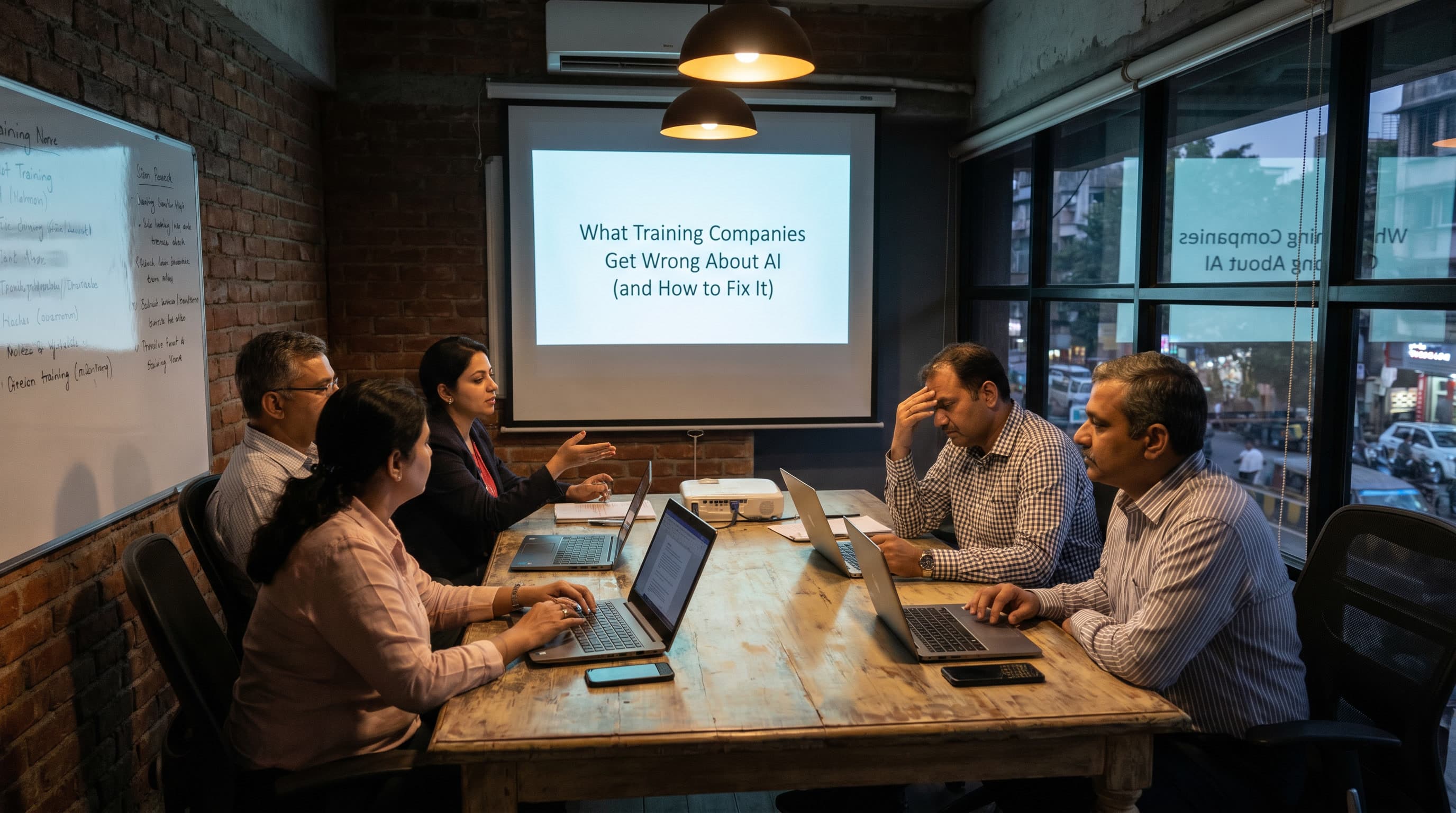
What Training Companies Get Wrong About AI (and How to Fix It)
Most training companies that engage with AI start in the same place: they add AI as a module to an existing course, or they build an entirely new course on AI as a topic. Both approaches miss the point almost entirely.
The training companies seeing real results from AI are not teaching it. They are using it — as a production tool that runs through everything they do.
The "AI as Content" Trap
Here is what the wrong approach looks like:
A corporate training provider adds a "Generative AI for Professionals" module to their leadership programme
A soft skills academy builds an AI literacy course for client organisations
A compliance training company creates an AI awareness module for regulated businesses
None of these are bad products. But none of them change how the training company actually operates. The curriculum is still designed the same way. The materials are still produced the same way. The learner outcomes are still measured the same way.
AI has been added to the product — but not to the production line.
What Training Companies Actually Need AI For
The real opportunity is in the production infrastructure of a training company. Four areas create the most leverage.
Programme design. A skilled instructional designer can map a learning pathway for a new client in a few hours. An AI-assisted design process can do the same mapping in minutes — then let the designer spend their time on judgment, customisation, and the parts that actually require human expertise. Most training companies employ far fewer instructional designers than they need because the work is slow. AI removes the bottleneck.
Content generation and personalisation. Generic course content is the biggest quality complaint in corporate training. Learners want materials that reflect their industry, their role, and their specific challenges. AI can generate scenario-based content at the industry and role level in a fraction of the time it takes to write from scratch — and then personalise further per learner cohort.
Assessment and measurement. Most training companies still measure learning through attendance records and post-course feedback forms. Neither tells you whether anything changed. AI-assisted assessment can generate scenario-based questions, evaluate open-ended responses at scale, and track knowledge retention over time. This turns a compliance checkbox into an actual outcome.
Administrative overhead. Scheduling coordination, pre-work reminders, post-session follow-up, LMS updates, reporting to procurement — all of this is repeatable, rule-driven work. For a training company delivering 50 programmes a year, this administrative load consumes enormous capacity that should be spent on learning design.
The Three Signs You Are Ready
A training company is ready to use AI as a production tool when it can answer yes to three questions:
- Do you have documented processes for how your programmes are designed and delivered — or is it all in people's heads?
- Do you collect structured data on learner outcomes — not just attendance and satisfaction scores?
- Is there someone in your organisation who can own an AI system after it is built — to maintain it, improve it, and use it consistently?
If you answered no to any of these, the value of AI will be limited until you address the underlying process problem. This is not a criticism — it is the honest prerequisite.
Where to Start
For most training companies, the highest-leverage first step is content personalisation at scale. If you currently take 20 hours to customise a standard programme for a new client, AI can cut that to four — with a better result, because the customisation is more granular than your team currently has time to produce.
The second step is assessment. Replace post-course feedback forms with AI-generated scenario assessments that test application, not just recall. This gives you data your clients actually want to see.
The third step is programme design automation. This is where the deepest leverage is — but it also requires the most process documentation before AI can assist it.
Contact us if you want to work through which of these three is the right starting point for your organisation.
About the Author
Ayan Biswas
Founder, YPD Technology Services FZCO. Three decades in industrial automation and AI systems. IIM Ahmedabad alumnus. Based in Dubai, UAE.
ayan.biswas@youthpulsedigital.com